ELV Regulation in the Automotive Industry
How Ultrasonic Joining Technology Supports the Use of Recycled Content
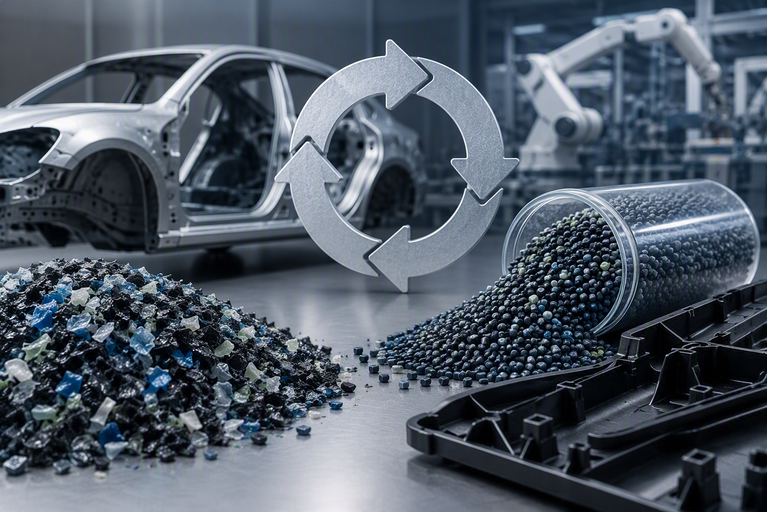
The proposed European End-of-Life Vehicles (ELV) Regulation sets ambitious circular economy targets for the automotive industry. According to the current proposal, starting in 2030, at least 25% of the plastics used in new vehicles must come from post-consumer recycled (PCR) content. A portion of this material is expected to be sourced directly from end-of-life vehicle recycling, helping establish closed-loop material streams within the automotive sector.
As a result, the use of recycled content is shifting from a voluntary sustainability initiative to a business requirement for OEMs and suppliers. The key question is no longer whether recycled plastics will be used, but how they can be integrated reliably and cost-effectively into high-volume production.
This raises an important challenge for manufacturers and suppliers:
How can increasing levels of recycled content be combined with the strict quality requirements and cost pressures of automotive manufacturing?
Recycled Content Changes Manufacturing Requirements
Advanced recycling technologies already make it possible to recover high-quality plastics from end-of-life vehicles.
However, the real challenge often begins during processing.
Compared to virgin materials, recycled plastics can exhibit different material characteristics. Aging, previous use, and reprocessing may influence thermal and mechanical properties, affecting production performance and process stability.
For manufacturers, this can result in:
- Variations in material properties
- Changes in processing behavior
- Additional validation efforts when introducing new material grades
As a result, reliable joining processes are becoming increasingly important.
Reliable Joining Becomes a Key Success Factor
To successfully implement recycled content in high-volume automotive applications, joining processes must consistently deliver reliable results despite material variations between batches.
Key requirements include:
- Repeatable results
- High joint strength
- Cost-efficient cycle times
- Stable processes despite material variability
The choice of joining technology can therefore play a critical role in determining how easily recycled content can be integrated into existing manufacturing operations.
Ultrasonics Shows Strong Potential for Recycled Plastics
This is where ultrasonic welding offers significant advantages. By delivering energy precisely to the weld zone, manufacturers can use intelligent process control to adapt welding parameters to varying material characteristics.
The potential of ultrasonic welding for recycled plastics is demonstrated by a feasibility study conducted by Herrmann Ultrasonics. The study evaluated the weldability of recycled PA 6.6 GF30 compared to virgin PA 6.6 GF30. The result: after optimizing the welding parameters, the recycled material achieved joint strengths comparable to those of the virgin material.
The findings demonstrate that recycled plastics do not necessarily compromise product quality. Instead, success depends on adapting process parameters to the specific characteristics of the material.
As recycled content requirements continue to increase, the flexibility of ultrasonic joining technology becomes even more valuable. It enables manufacturers to integrate new material grades, evolving recycled content streams, and higher recycling targets into existing production concepts with confidence.
Learn more about the Herrmann feasibility study.
Unlocking Economic Benefits
Ultrasonic welding can help manufacturers not only process recycled content reliably, but also improve overall production efficiency.
Short cycle times, low energy consumption, repeatable processes, and the elimination of additional joining materials all contribute to lower manufacturing costs. At the same time, stable processes help reduce scrap rates and make more efficient use of valuable material resources.
As a result, the ELV Regulation is not only driving sustainability initiatives but also creating opportunities for more cost-effective manufacturing.
Conclusion: ELV Drives New Manufacturing Concepts
With the introduction of the ELV Regulation, circular economy principles are becoming an increasingly important part of product development and manufacturing. In the future, securing suitable recycled materials will be only part of the challenge. Companies must also ensure that these materials can be processed reliably and efficiently in production.
At the same time, Design for Recycling is becoming a key consideration in the development of next-generation vehicle components.
For many years, Herrmann Ultrasonics has been investigating the processability of sustainable plastics. Insights gained from welding recycled materials help evaluate new material grades at an early stage and define robust process windows for series production.
Can Your Recycled Material Be Reliably Joined with Ultrasonics?
Our application experts can evaluate the weldability of your recycled plastics and identify the optimal process parameters for your application.
Schedule a consultation in our state-of-the-art ultrasonic laboratory and benefit from meaningful testing with your materials under real production conditions.
Contact our experts today and discover how ultrasonics can help you achieve your sustainability and manufacturing goals.